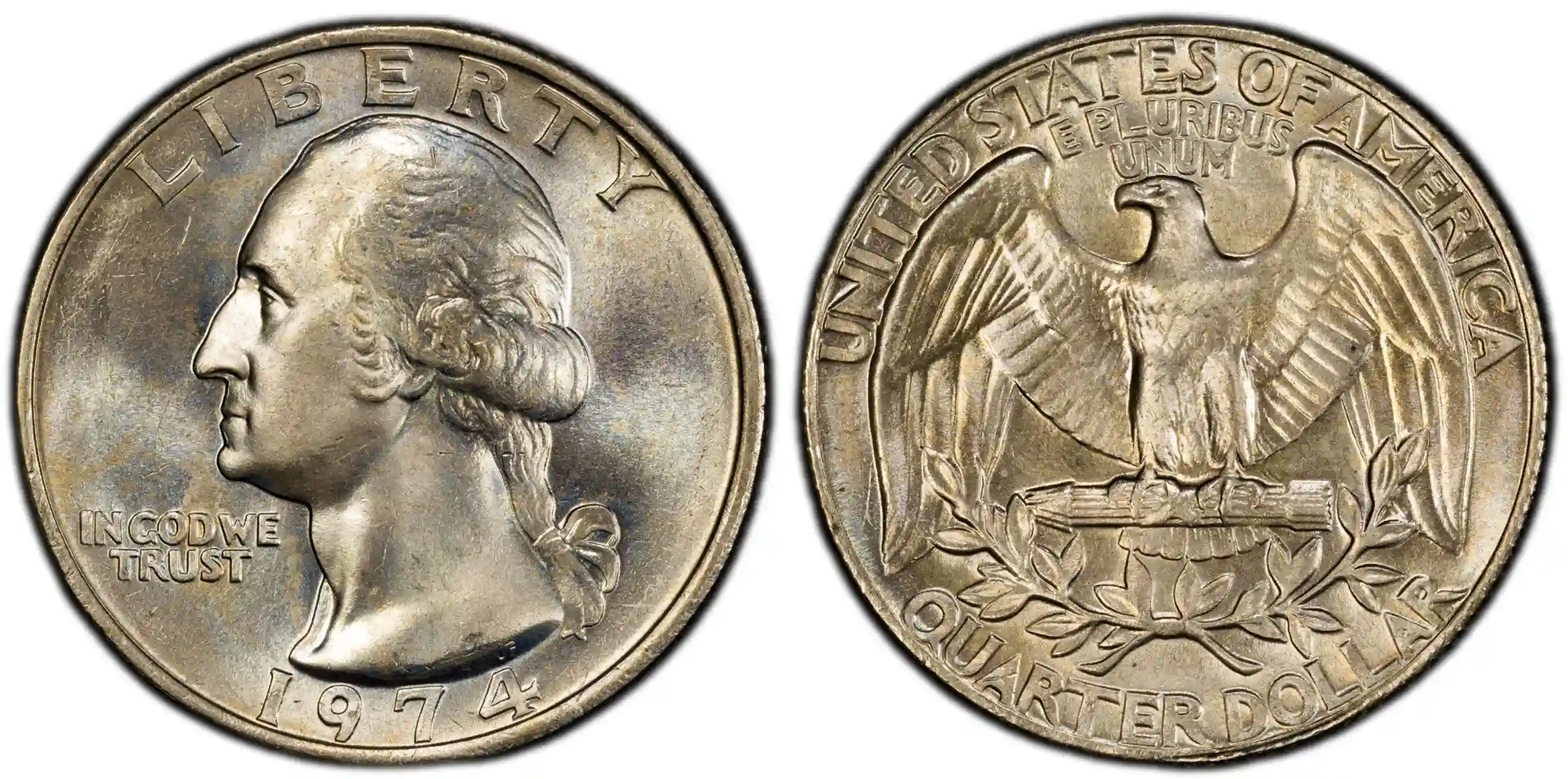
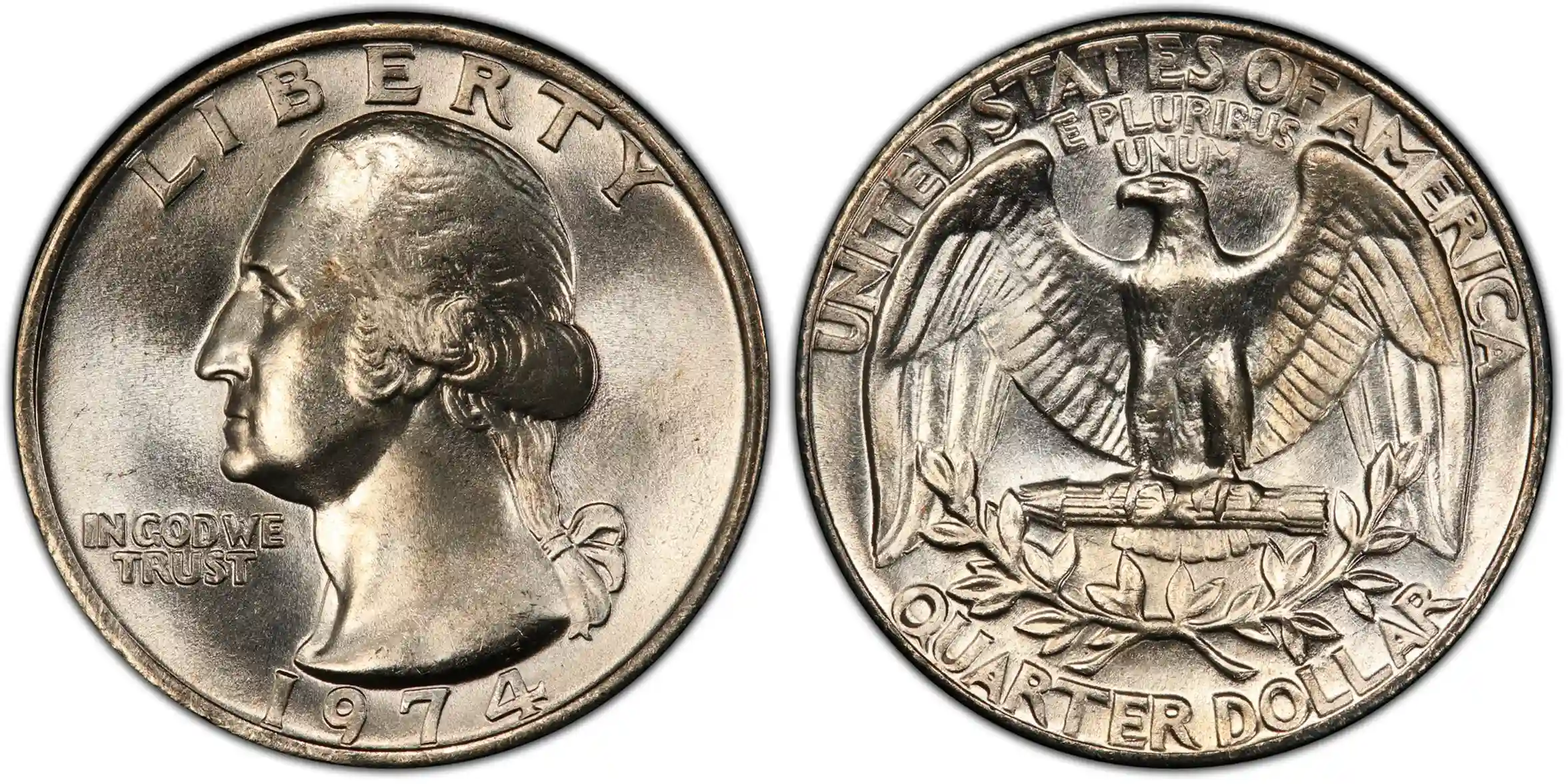
1974 Quarter Errors and Varieties
The 1974 quarter no mint mark value ranges from $0.25 to $260 or more for Mint State 67, but items with errors, such as DDO or Wrong Planchet up to $300.
Specifications of the 1974 Washington Quarter
To find valuable errors in common issues, you must first know the exact parameters of a normal coin. Most of these coins match standard specifications perfectly. If you encounter a quarter that deviates from these official standards, you may hold a rare error.
Year | 1974 |
Diameter | 24.30 mm |
Weight | 5.67 g |
Composition | 91.67% copper, 8.33% nickel |
Edge | Reeded |
Mint Marks and Production Quantities
Three different mint facilities produced the Washington quarter in 1974. The location of production determines the presence and style of the mint mark, which sits on the obverse side to the right of Washington's ponytail.
Mint | Mint Mark | Mintage | Coin Type |
Philadelphia | None | 801,456,000 | Business Strike |
Denver | D | 353,160,300 | Business Strike |
San Francisco | S | 2,612,568 | Proof Strike |
Major 1974 Quarter Errors to Watch For
The massive production numbers in 1974 led to several mechanical slip-ups at the mint. These manufacturing mistakes created unique varieties that now command significant premiums among collectors.
Doubled Die Obverse and Reverse
A doubled die error occurs when the hub transfers the design to the working die at a slightly misaligned angle during manufacture. This mistake causes doubled lines on the struck coins.
Inspect the obverse letters in the phrase and the numbers in the date. Look for clear, flat, parallel shelf-like lines on the curves of the letters.
Value $10–$300
Off-Center Strikes & Die Misalignments
An off-center strike happens when the machinery fails to position the planchet correctly within the collar. The die strikes only a portion of the metal disc.
The price of an off-center error depends on the percentage of the missing design. A quarter that misses 50 percent of the strike holds a high value.
Value $20–$150+
Missing Clad Layers and Split Planchets
Sometimes the bond between the copper-nickel outer skin and the pure copper core fails before the strike occurs. This separation creates a missing clad layer error. A quarter with a missing clad layer will display a standard nickel-colored side on one face, while the opposite face displays a red copper surface.
Value $40–$150+
Rare Transitional and Wrong Planchet Anomalies
The most valuable errors occur when the coin press strikes a Washington quarter design onto a metal blank intended for a completely different denomination. These wrong planchet errors sometimes escaped the mint inside bulk bags.
1974 Quarter Struck on a Dime Planchet
A dime planchet is much smaller and thinner than a quarter planchet. When a dime blank accidentally entered the quarter coin press in 1974, it produced a highly collectible anomaly.
The quarter design is too large for the small dime blank. Because of this, the outer portions of the design, including the date and the letters of LIBERTY, are cut off at the edge.
Value $300+
Struck on a Five-Cent Planchet
A five-cent nickel planchet consists of a homogeneous copper-nickel alloy and lacks the distinct red copper center stripe along the edge. A quarter struck on a nickel blank will have a thick, silver-colored edge with no copper stripe. The design details near the rim will show distortion or clipping because the nickel blank is smaller than a quarter blank.
Value $300+
Valuation of Standard Items
If your 1974 quarter does not show any errors, its value depends entirely on its physical condition. Most of these coins spent decades in circulation and carry no premium.
Circulated vs. Mint State Price Guide
Circulated quarters from 1974 show flattened details on Washington's hair and the eagle's breast feathers. These coins are worth exactly their face value. Coins that never entered circulation retain their original luster and carry a premium.
Grade | Philadelphia | Denver |
Circulated (G to AU) | $0.25 | $0.25 |
Mint State 63 | $2.00 | $2.00 |
Mint State 65 | $18.00 | $20.00 |
Mint State 67 | $260.00 | $125.00 |
The information value from PCGS can fluctuate.
Auction Records
At the absolute highest grades, collectors will pay massive sums to acquire the finest known specimens for their registry sets.
MS-67+ Philadelphia – $2,115
MS-67+ Denver – $1,450
PR70 Deep Cameo San Francisco – $10,925
Step-by-Step Inspection Process
Step 1 – Use Special Numismatic Equipment
Loupe – avoid high-powered microscopes for initial inspections. A simple 10x jeweler's loupe provides the ideal magnification to spot genuine doubled dies without visual distortion.
Digital Gram Scale — acquire a scale that measures down to 0.01 grams. Weigh every quarter you inspect. A weight of 5.67 grams is normal, but a weight near 5.00 grams or 2.27 grams immediately reveals a rare planchet error.
Step 2 – Safe Storage and Handling Tips
Hold by the Edges – never touch the flat faces of the coin with your bare fingers. Skin oils contain natural acids that can dull the luster and leave permanent dark spots on the metal.
Use Cotton Gloves – wear clean, lint-free cotton or nitrile gloves when you handle uncirculated issues.
Avoid PVC Holders – store your finds in PVC-free plastic flips or paper envelopes. Old plastic holders with PVC release chemical gases that ruin coin surfaces over time.
Where to Buy a 1974 Quarter with Errors?
Major auction companies handle certified error quarters regularly. These firms verify the authenticity of the coins before the sales start.
GreatCollections – the company hosts weekly online auctions where collectors bid on certified error coins.
Heritage Auctions – the firm holds large-scale sales where high-value wrong planchet errors and off-center strikes appear.
Stack's Bowers – collectors find certified 1974 errors in their regular physical and online catalog auctions.