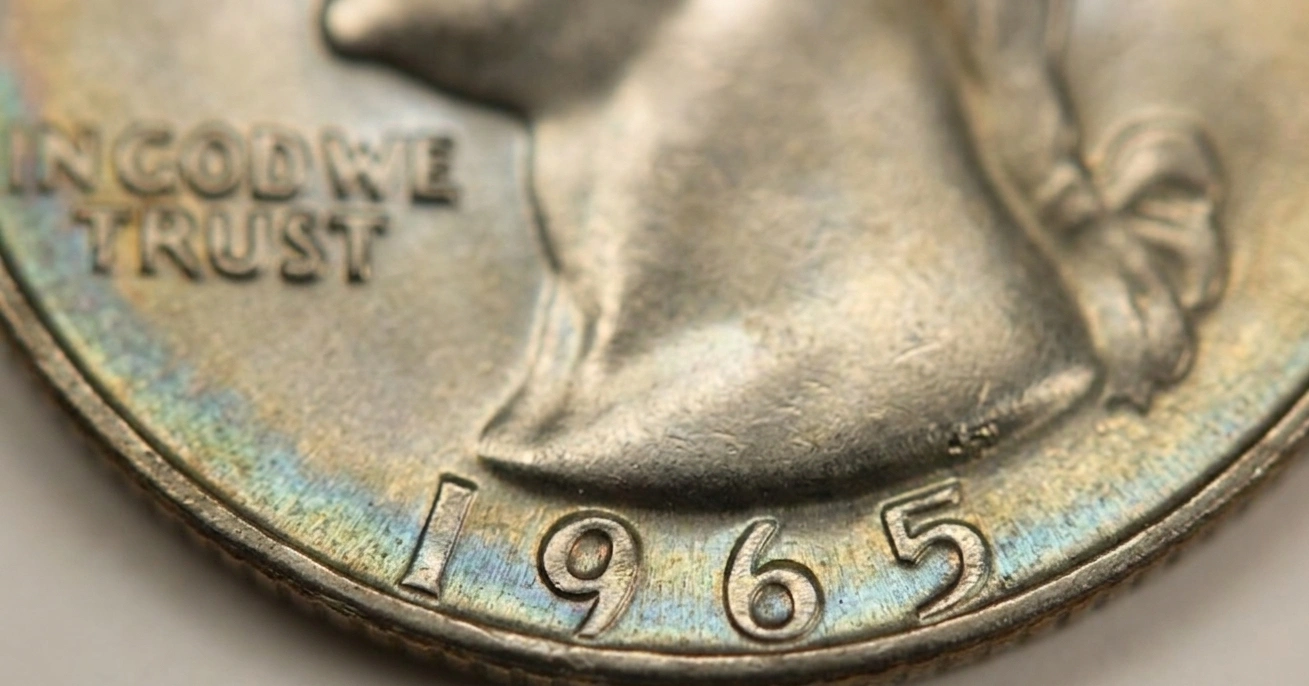
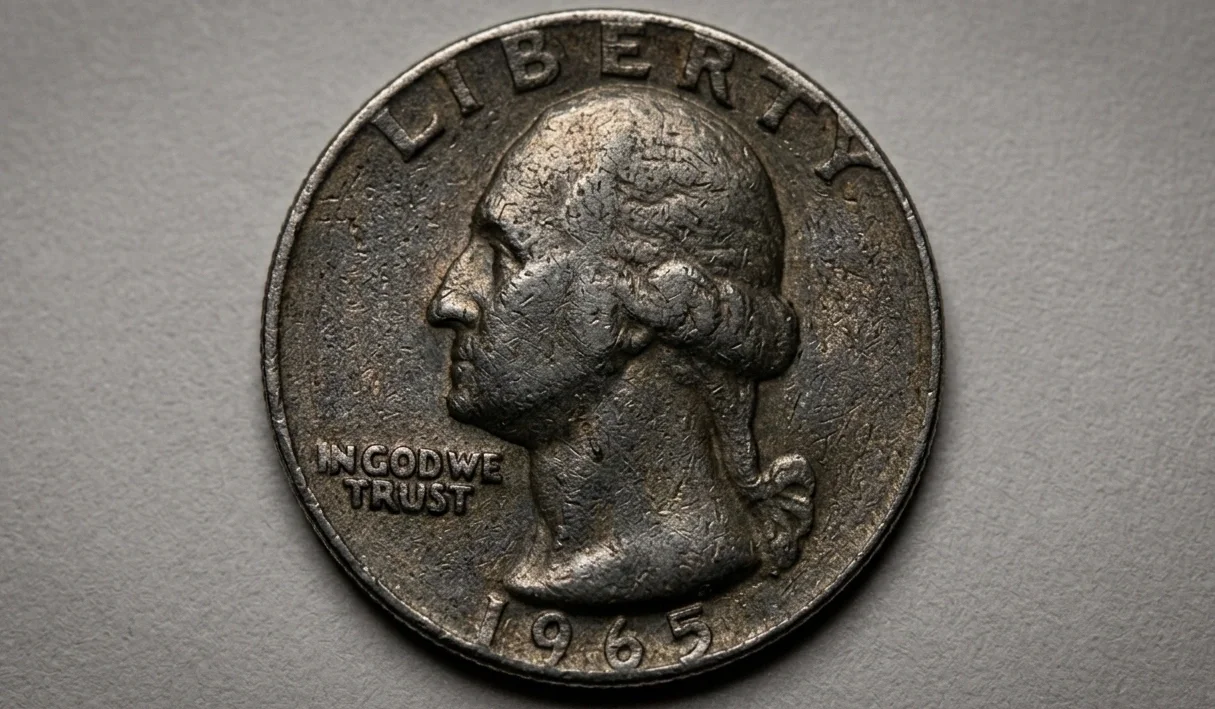
What Is a 1965 Quarter Worth in Today’s Collector Market
Transitional years often carry hidden significance.
The year 1965 marked a fundamental shift in the United States monetary system.
Legislative action regarding the Coinage Act of 1965 permanently removed silver content from this specific denomination.
Switching to a copper-nickel clad composition addressed the global shortage of precious metals. So, what is a 1965 quarter worth?
Parameter | 1965 Standard Value |
Total Weight | 5.67 grams |
Diameter | 24.26 mm |
Thickness | 1.75 mm |
Core Material | 100% Copper |
Outer Layer | 75% Copper / 25% Nickel |
Edge Type | Reeded (119 grooves) |
Employing clad technology allowed the coins to retain the magnetic properties required for period vending machines.
Visual identification of these coins involves checking for a visible copper stripe on the edge.
Current Market Value for Standard 1965 Issues
Market pricing for the vast majority of 1965 quarters remains capped at face value due to a massive mintage of 1,819,717,540 units.
Circulation wear reduces the investment appeal of these assets to minimal levels.
Current Price Statistics Based on Preservation State (2026):
Condition G4 - VF20 → $0.25
Condition EF40 - AU58 → $0.35
Condition MS60 - MS63 → $1.50
Condition MS65 → $15.00
Condition MS67 → $350.00
Annual price growth for coins in MS67 condition averages approximately 4.5% resulting from shrinking auction supplies.
Items graded below MS60 lose 10% in value every five years relative to currency purchasing power.
Using professional grading services remains logical only for coins lacking visible surface damage.
Transitional Errors and Rare Hybrid Varieties
Manufacturing failures during the transition period created the most valuable 1965 specimens.
Accidental use of leftover blanks from the previous production year yielded rare numismatic artifacts.
Mechanics of the Transitional Error: Silver blanks remaining from 1964 → Accidentally entering 1965 production bins → Creation of a silver coin dated 1965 → High-value rarity.
Identification Marks for the 1965 Silver Error:
Weight totaling exactly 6.25 grams.
Complete absence of a copper line on the edge.
Pure silver luster when viewed under angled light.
Distinct high-pitched ringing sound when dropped on a hard surface.
A record auction price for a 1965 silver quarter in MS62 condition stands at $16,800.
Owning such a specimen elevates an individual's standing within professional circles.
Auction Performance and Sales Dynamics
Analysis of completed sales at Heritage Auctions and Stack’s Bowers indicates sustained interest in exceptional units.
Maximum prices occur only when coins are secured within professional plastic holders.
Top 3 Sales Records for the 1965 Quarter:
MS68 (PCGS) → $12,650 (Sold in 2020)
MS67+ (NGC) → $3,840 (Sold in 2019)
Mint Error Silver Blank MS62 → $16,800 (Absolute Record)
Finding a 1965 quarter in MS68 condition involves a probability of less than 0.0001%.
Introducing a new confirmed MS68 specimen to the market immediately causes a 15–20% price correction downward.
Investors categorize such positions as long-term capital preservation tools.
Production Defects and Their Financial Impact
Damaged minting equipment creates unique visual characteristics on the coin surface.
Value for defective coins depends directly on the severity and type of the flaw.
Double Struck → Image displacement caused by repeated die impact.
Price for 50% displacement → $450.
Wrong Blank → Striking on blanks intended for 5 or 10 cent denominations.
Price for a 10-cent blank strike → $1,200.
Die Crack → Raised lines on the surface resulting from steel fractures.
Price for major cracks → $85.
Struck Through Grease → Lost design details caused by trapped lubricant.
Price for total date loss → $50.
Combining multiple errors on a single coin increases its value exponentially.
Minor scratches and dents acquired during circulation do not qualify as production errors.
Preservation Factors and Metal Degradation
The chemical stability of the copper-nickel alloy exceeds that of silver counterparts.
Environmental factors exert constant pressure on the metal's top layer.
Causes of Asset Value Reduction:
Mechanical friction against other coins → Surface detail erosion.
Moisture exposure → Development of dark oxide spots.
Harsh cleaning agents → Destruction of original mint luster.
PVC contact in storage albums → Green sticky residue.
To prevent these, regularly check it via a coin scanner app free.
Losing original mint luster automatically demotes a coin from the luxury category to common circulation status.
Professional lab cleaning costs average $25 per specimen in 2026.
The Numismatic Market Structure in 2026
Digitalization of trading processes has simplified the authentication of rare issues.
Global auction house reach provides high liquidity for certified assets.
Demand Distribution by Buyer Category:
Investment Funds → 15% (Targeting MS67 and higher)
Private Collectors → 65% (Filling date sets)
Specialized Dealers → 20% (Searching for mint errors)
The year 2026 shows increased interest in transitional period coins among younger demographics.
Utilizing mobile scanning applications allows for rapid filtering of clad coins from silver versions.
Comparative Analysis: 1964 vs 1965
Differences in metal composition determine the massive price gap between these years.
Visual similarities in the Washington design often mislead inexperienced owners.
Feature | 1964 Issue | 1965 Issue |
Composition | 90% Silver, 10% Copper | Copper-Nickel Sandwich |
Intrinsic Metal Value | $4.50 (at $25/oz silver) | $0.05 |
Mint Mark | Present (D or S) | Absent |
Collection Status | Precious Metal | Base Metal |
Transitioning to a clad base saved the US Treasury millions of dollars in production costs.
1964-dated coins continued production into 1965, creating complications in official statistics.
Special Mint Set (SMS) Technology (1965)
Instead of traditional Proof sets, 1965 saw the release of Special Mint Sets for collectors.
SMS production involves using polished dies and increased press pressure.
Distinguishing Features of SMS Coins:
Sharper details in Washington’s hair.
Smooth fields lacking heavy polish lines.
Absence of the mirror-like finish found on Proofs.
Lack of contact marks from other coins.
Value for an individual 1965 SMS quarter in MS67 condition is approximately $20.
Specimens displaying a frosted image against a brilliant field carry the Cameo designation.
Prices for a 1965 SMS Cameo quarter can reach $500 in specialized auctions.
Searching and Identifying Rare Varieties
Locating rarities requires using optical tools with at least coin appraisal app free.
Most valuable errors remain hidden within microscopic design details.
Coin Verification Algorithm: High-precision scale → Weighing the unit → Recording weight.
Jeweler’s loupe → Inspecting the date area → Checking for doubling.
Microscope → Examining the edge → Verifying the copper band.
Database comparison → Identifying the market niche.
Finding a 1965 silver quarter in loose change remains mathematically unlikely though documented three times.
Most discoveries occur when processing old bank-wrapped rolls.
Storage Rules for Valuable Specimens
Preserving value requires eliminating contact with oxygen and skin oils.
Professional accessories prevent the development of corrosive processes.
Using acid-free plastic capsules for isolation.
Storing in safes with humidity controlled below 40%.
Wearing cotton gloves during all handling procedures.
Avoiding rapid temperature changes in the storage area.
Violating storage conditions for a single year can drop a coin's grade from MS67 to MS64.
Restoring lost luster through chemical means is considered permanent damage.